We asked Dr. Adolfo Leyva-Alvizo, a member of the SURGhub Content Committee, about the rural postings that first drew him to global health, what safe surgery depends on, and why his team now uploads its courses in two languages. He has worked with surgery residents and medical students at TecSalud, the health branch of Tecnológico de Monterrey, since 2007. He is a general surgeon with a master’s degree in education and today serves as Surgery Academic Coordinator. In a regular week that means sessions, patient clinics and operations with both undergraduate and postgraduate students.
Empty space, drag to resize
“We are sent to be the surgeon in a rural hospital for four months”
Empty space, drag to resize
His route into global health started with Mexico’s health system, which he describes as having “lots of deficiencies”, and with the way the country trains its doctors. “When we finish med school we do a complete year of social service, many of us in rural areas, as primary contact physicians, and at the end of our surgical training we are sent to be the surgeon in a rural hospital for four months,” he says, “so since then I started to see how we can improve the coverage in needed areas.”
He spent those four months in Galeana, Nuevo León, a small town in the mountains between Monterrey and the city of San Luis Potosí. “During that stay I had the opportunity to operate in a couple of trauma cases, because we were the closest hospital to the interstate highway in a large segment,” he says. “Starting there I noticed there was lot to be done in rural and small areas outside the three big cities in Mexico.”
Empty space, drag to resize
“Safe surgical care covers a lot of areas, not only the surgery itself”
Empty space, drag to resize
Alongside his teaching, Dr. Leyva-Alvizo works as a surgical expert witness, reviewing legal cases “in which poor adherence to protocols as simple as antibiotic prophylaxis, surgical sterilisation, etc can lead to complications and/or elevate costs”.
“Safe surgical care covers a lot of areas, not only the surgery itself, and we need to train techs, nurses, residents, etc in order to cover all the protocols and processes,” he says.
Empty space, drag to resize
“The language barrier continues to be important in Latin American countries”
Empty space, drag to resize
Dr. Leyva-Alvizo has been teaching for 19 years, and that experience is why he accepted a place on the SURGhub Content Committee, which decides on the appropriateness and quality of the platform’s content. “Through these years I have seen the importance of transmitting knowledge in innovative and different ways, according to the target population,” he says.
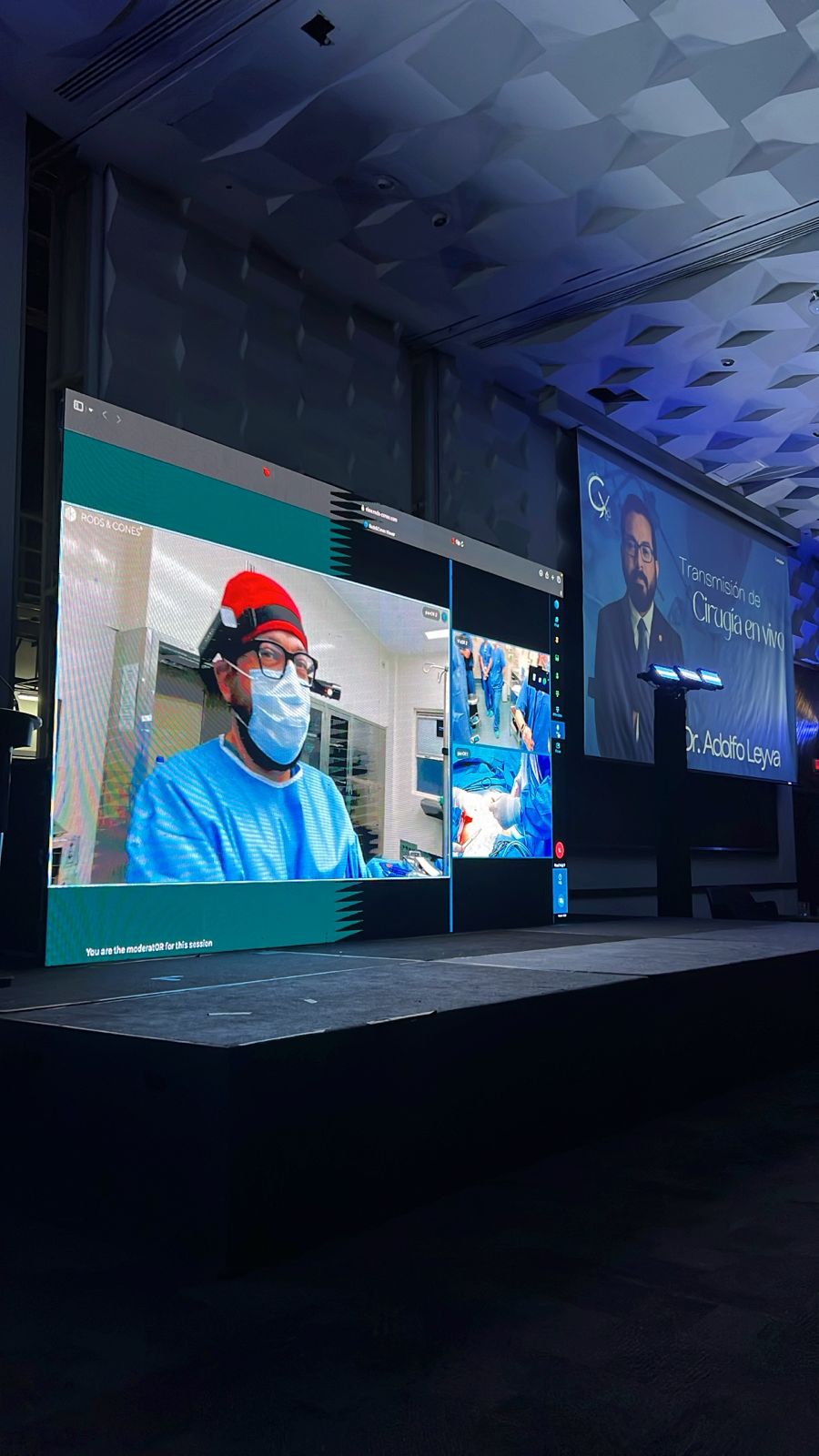
Dr. Adolfo Leyva-Alvizo operating at Hospital Zambrano Hellion, broadcast live to the Surgery Congress of Tecnológico de Monterrey. Photo: Michelle Elizondo-Clariond, CEIC.
Empty space, drag to resize
Live surgery is one of those ways. “The advantage of a live surgery is that questions can be solved at the moment, students appreciate a lot the explanation, from anatomy to surgical technique, and they have the feeling they were there, living the experience,” he says. “I think all this together makes the experience more complete and easier to remember.” For the broadcast pictured above, one camera filmed the whole operating theatre, a second camera and a microphone attached to his head showed what his hands were doing, and the laparoscopic camera showed the steps of the operation inside.
He contributes courses as well, together with his residents and professors at TecSalud. “We are trying to spread the use of SURGhub in Latin American countries,” he says.
“I think the internet, smartphones, tablets, etc have increased the availability of long distance training and enhanced communication between colleagues,” he says. “This has improved surgical care in rural and distant areas.”
“Even so, the language barrier continues to be important in Latin American countries, that’s why we decided to start uploading content in both languages.”
“I first noticed, while working for the content committee, that we had almost no content in Spanish at that time,” he says. His surgery residents helped develop the courses, with him as primary reviewer.
“Preventive culture in countries like ours is still a problem,” he says. “So maybe adding more preventive medicine courses will help in the long run in countries like Mexico.”
Empty space, drag to resize
“The number of patients to benefit can be countless”
Empty space, drag to resize
Feedback on the suture course has come from doctors in rural Oaxaca and Tabasco doing their social service year, “who found it helpful to solve their needs”.
To someone starting out in this work, he says: “If only one person in a place far away from yours, learns and applies the knowledge from one of your courses, the number of patients to benefit can be countless! You never know who is needing the skills or knowledge you have, that can be shared through this platform.”
Empty space, drag to resize
Adolfo’s Top Course
Suture Technique
Topic: General Surgery, Basics of Surgery for Non-Specialists
Description: Learn the basic concepts on suture characteristics, selection, and specific uses, type of stitches and proper technique for removal.
“The suture course is my favourite because it is very practical, and also, it is our most downloaded course.”
– Dr. Adolfo Leyva-Alvizo
This profile is part of our Committee Member Stories series, which highlights the members of the committees behind SURGhub. Our mission is to ensure that high-quality surgical education is a bridge—not a barrier—to saving lives worldwide.
The views and opinions expressed in this article are those of the interviewee and do not necessarily reflect the official policy, position, or standpoint of SURGhub or its partner organisations.