Nov 5 • SURGhub Team

Beyond the Screen: Dr. Andrea Cárdenas González on Taking Online Learning into Theatre

A third-year General Surgery resident at a public hospital in Querétaro, Mexico, Dr. Andrea Cárdenas González explains what draws her to reconstructive surgery, and how a SURGhub course on appendicitis gave structure to her practice on a box trainer.

Surgical professionals around the world use SURGhub to improve patient outcomes. In this series we highlight their stories.
Querétaro, Mexico. Dr. Andrea Cárdenas González wants to spend her career giving patients back what trauma, burns or cancer can take away: movement, function and a sense of self. For now she is in the middle of residency, where she has learned that the operation is only part of the job. “Residency has taught me that surgery is much more than operating,” she says.

Hospital General Querétaro is a public hospital in a city of more than a million people in central Mexico. The historic centre, with its Baroque churches and colonial aqueduct, has been a UNESCO World Heritage site since 1996, and the surrounding state has built up aerospace and automotive industries. Dr. Cárdenas is in her third year of General Surgery residency here.
Empty space, drag to resize
“What keeps me motivated is the patient in front of me”
Empty space, drag to resize
Her day starts early, reviewing the patients on the ward before rounds. After that it can change quickly. She may be in theatre, assessing patients in the emergency department, answering surgical consultations, helping with inpatient care or following patients after their operations. On call, the same rhythm carries on through the night.

Residency has taught her what that involves: making decisions under pressure, talking with patients and families, working as part of a team, and still studying at the end of a very long day.

Working in the public system means caring for a large and varied patient population, often with limited time, theatre availability, equipment or other resources. Those limits force the team to prioritise carefully, communicate well and use what is available responsibly. They also make education more important, she says, because good clinical judgement is worth even more when not every ideal resource is immediately to hand.

After a difficult shift, the fatigue is easy to remember. So is the patient who improves, the family who finally receives good news, or the moment when something she studied helps her understand a problem more clearly. “What keeps me motivated is the patient in front of me,” she says. Residency is temporary, she reminds herself, but the surgeon she is becoming through it will stay with her for the rest of her career.
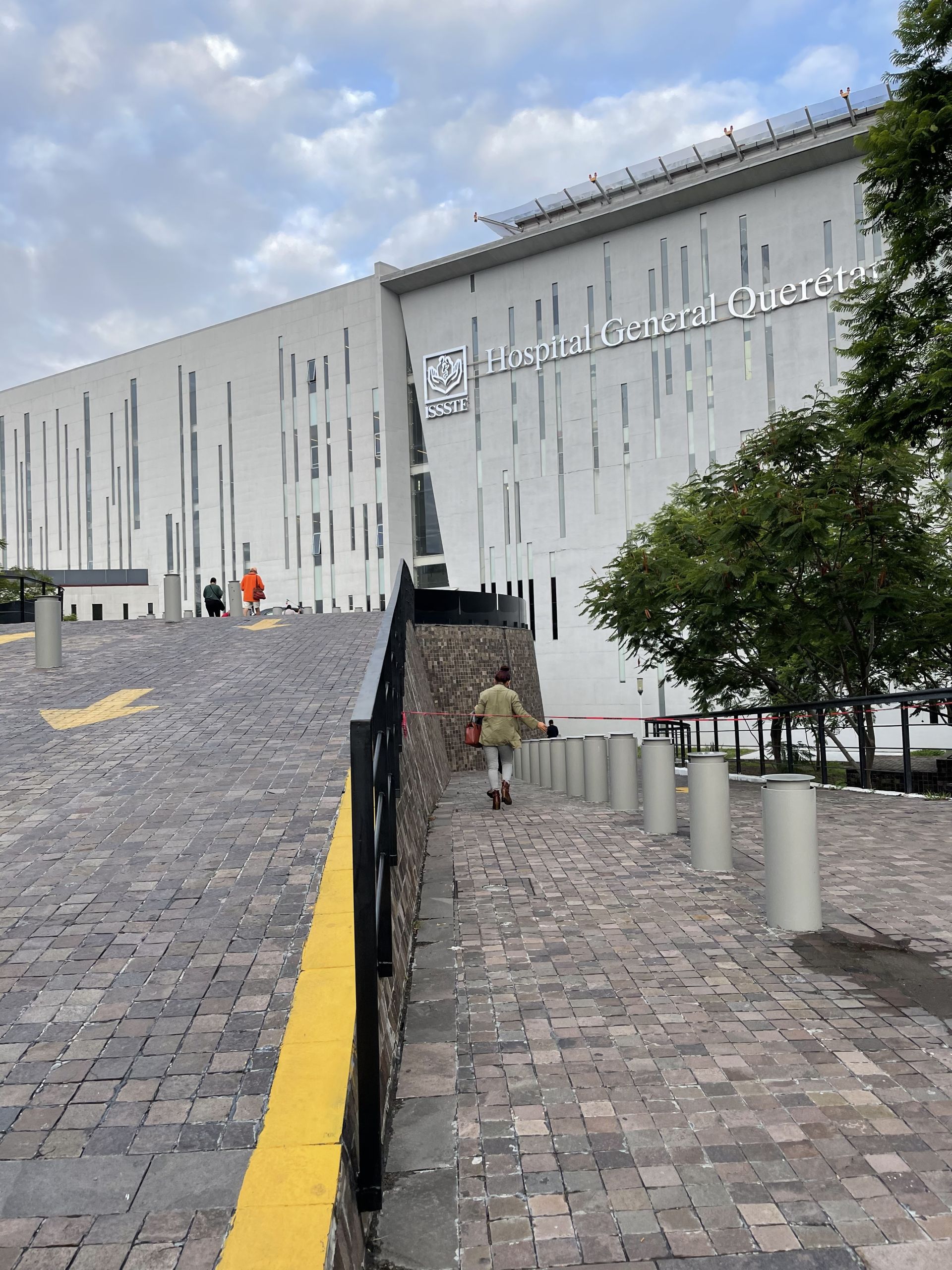
Entrance to Hospital General Querétaro, ISSSTE
Hospital General Querétaro, ISSSTE, where Dr. Andrea Cárdenas González is a third-year General Surgery resident.
Empty space, drag to resize
“Reconstruction goes far beyond aesthetics”
What attracted Dr. Cárdenas to surgery was the chance to identify a problem and intervene directly to solve it, and often to see a tangible change in the patient’s condition as a result.

Her long-term aim is to go on from General Surgery to train in Plastic, Aesthetic and Reconstructive Surgery. She is particularly interested in reconstruction, microsurgery, hand surgery, peripheral nerve surgery and burn care.

She thinks about reconstruction in terms of what it gives back to a patient. A hand lets someone work, write, touch and interact with the world. The face is central to communication, expression and the way people recognise themselves and each other. After trauma, burns, cancer or a congenital condition, reconstruction can help a patient regain form and function, and a sense of self.

“Reconstruction goes far beyond aesthetics,” she says. “Surgery can solve a problem, but reconstructive surgery can also help give patients back something that allows them to live, function, and feel like themselves again.”
“Accessible education is powerful precisely because it can become part of everyday clinical life”
Empty space, drag to resize
She found SURGhub while looking for structured, accessible surgical education that she could fit into residency. What appealed to her straight away was the chance, as she puts it, to learn from high-quality surgical content without needing to be at a particular institution or in a particular country. For residents, whose schedules are rarely predictable, that matters.

Her courses have ranged from acute appendicitis and laparoscopic cholecystectomy to acute burn care, vascular trauma, head and neck reconstruction, cleft surgery, facial paralysis, skin cancer and several reconstructive techniques.

She rarely has a long, uninterrupted stretch to study, so rather than wait for the perfect schedule she fits the platform around residency: after rounds, between clinical duties, after a shift, or reading up on a topic before she meets it in theatre. “For me, accessible education is powerful precisely because it can become part of everyday clinical life,” she says.
Empty space, drag to resize
“Arriving in the operating room better prepared”
Empty space, drag to resize
The clearest example she gives is acute appendicitis. After completing the Appendicitis course, she wanted to go beyond reviewing the clinical management of these patients and improve her laparoscopic skills outside theatre. She was already using low-cost simulation on a box trainer to rehearse the fundamental laparoscopic movements safely and repeatedly. The course gave that practice more structure, she says, and connected the exercises more directly with the steps and decision-making involved in laparoscopic surgery.

Later in residency, operating on patients with acute appendicitis as primary surgeon under supervision, she noticed that the preparation had changed how she approached the case. She was more deliberate about the sequence of the procedure, instrument handling, respect for tissue and visualisation, and about anticipating the next surgical step rather than simply reacting to it. So far she has performed two laparoscopic and six open appendicectomies as primary surgeon.

No single manoeuvre made the difference, she says. It was something quieter and, in her view, just as important: “arriving in the operating room better prepared.” For the patient, that preparation means safer and more thoughtful surgery.
“Online education does not have to remain on a screen”
The appendicitis cases taught her something broader. “That experience showed me that online education does not have to remain on a screen,” she says. Combined with simulation, supervision and clinical practice, it can change the way surgeons care for real patients.

Her hope is that access to good surgical care, and to good surgical education, comes to depend less on geography or resources. There are highly motivated students, residents and surgeons everywhere, she says. What is not shared equally is access to mentors, simulation, specialist centres, research opportunities and high-quality teaching material, and platforms that make knowledge easier to reach can help narrow that gap.

Her advice to students starting out is direct. “Do not wait until you feel completely ready before you begin learning something difficult,” she says. Ask questions, look for mentors, practise, and read beyond what is required. There will be moments of tiredness and uncertainty, and the answer is to keep learning anyway.

“Never forget that behind every technique, algorithm, operation, or new skill there is a patient trusting you with something that matters deeply to them,” she says. “That responsibility is what makes all of the training worthwhile.”
Empty space, drag to resize

Andrea's Top Course
Appendicitis

Topic: A practical course to master the principles and safe laparoscopic management of appendicitis in resource-limited surgical settings.

Description: This course is designed to teach surgeons, and procedural trainees the principles of evaluation of a patient with appendicitis and their management through laparoscopic surgery in a resource-constrained setting.

"This course showed me that online education does not have to remain on a screen."

- Dr. Andrea Cárdenas González


About this Story

This profile is part of our Impact Stories series, highlighting how SURGhub learners are applying global surgical standards to local challenges. Our mission is to ensure that high-quality surgical education is a bridge—not a barrier—to saving lives worldwide.

The views and opinions expressed in this article are those of the interviewee and do not necessarily reflect the official policy, position, or standpoint of SURGhub or its partner organisations.
 SURGhub is a joint initiative of
 Supported by
In association with
Global Surgery Foundation
United Nations Institute for Training and Research
RCSI Institute for Global Surgery
Johnson & Johnson Foundation
Empty space, drag to resize

Related Courses

More ALL-SAFE courses